Inventory Script | ox_inventory Compatible, Admin Panel & Crafting
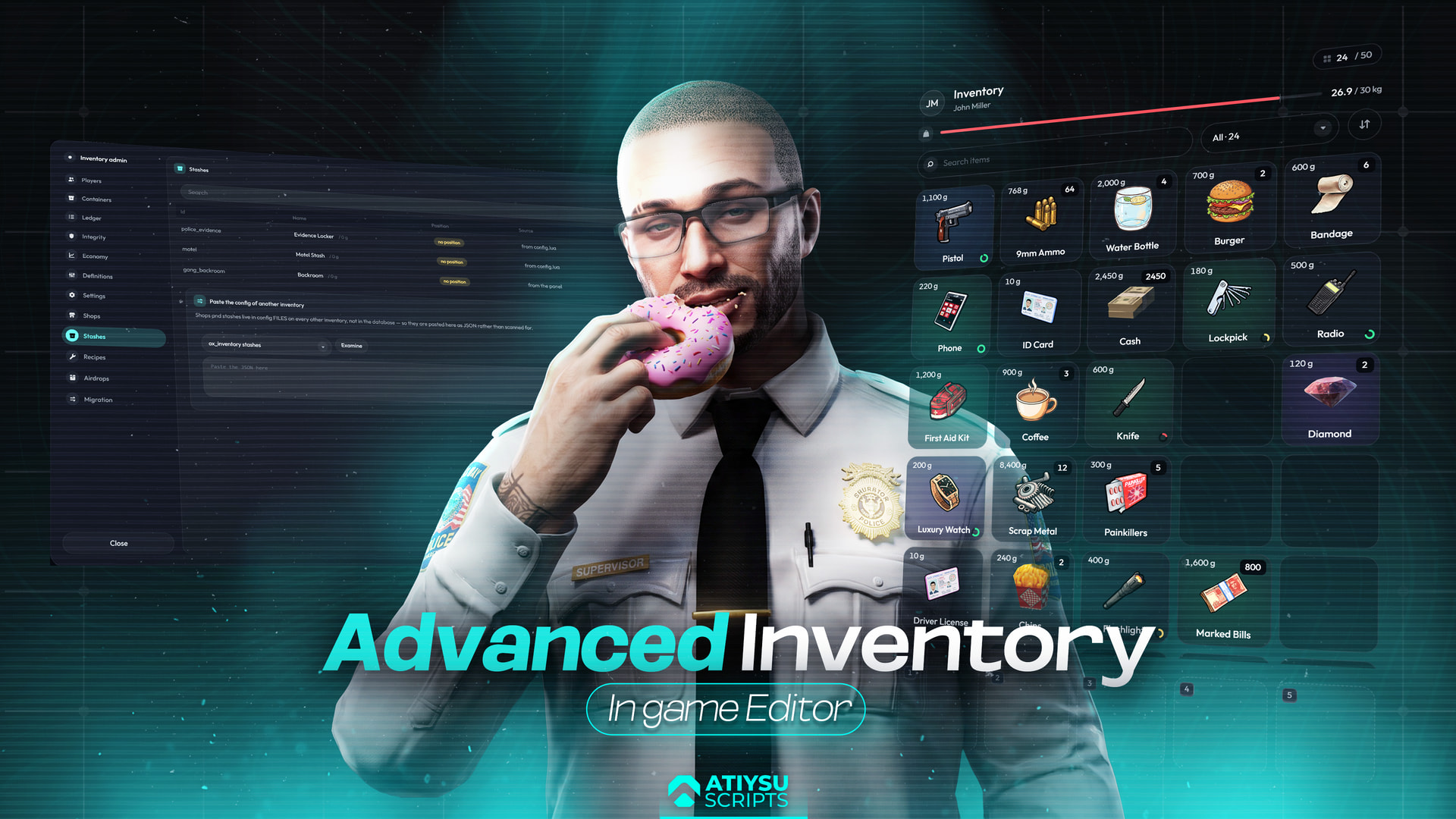
Inventory Script | ox_inventory Compatible, Admin Panel & Crafting


Preview

Click To Watch


Features)

  • Slot-Based, Server-Authoritative Core (Every Drag, Split, Trade And Craft Re-Validated Server-Side, Never Trusted From The Client)
  • Item Identity System (Serial Numbers, Ownership History, Bind Rules That Stop An ID Card Or Weapon Licence From Being Dropped Or Traded Away)
  • Weapon Depth (Attachments, Tints, Serial Trace, Per-Shot Durability Wear, Special Ammunition Types)
  • Freshness & Decay (Consumables Spoil On A Real Clock, Tools And Armor Wear Down And Can Break)
  • Interaction Suite (Search Corpses, Loot And Rob Other Players, Pick Locks On Stashes)
  • Clothing & Wear (Toggleable Character View, Wearable Items Bound To Ped Variation Slots, Armour Included)
  • Player Trading (Invite-Accept Trade Table, Both Sides Confirm Before Anything Changes Hands)
  • Crafting System (Recipe-Based, Ships With 9 Ready Recipes)
  • Placeable Items (Traffic Cones, Road Barriers, Radios And Toolboxes Set Down In The World)
  • Admin Panel (12 Tabs — Players, Containers, Ledger, Integrity, Economy, Definitions, Settings, Shops, Stashes, Recipes, Airdrops, Migration)
  • Ledger & Integrity Auditor (Every Change Recorded, Drift Between Server State And A Player’s Actual Items Flagged Automatically)
  • Migration Wizard (Dry Run, Backup And Restore — Import An Existing Inventory Save Without Losing A Single Item)
  • Airdrops (Scheduled Or Triggered Drops With Configurable Loot Tables)
  • Discord & Economy Logging (Webhook Logging, Economy Reports, Automatic Gain Alerts On Suspicious Spikes)
  • qb-core PlayerData Mirror (Scripts That Still Read PlayerData.items Directly Keep Working, Synced On Every Change)
  • 10 Localized Interfaces (English Plus German, Spanish, French, Italian, Dutch, Polish, Portuguese, Russian And Czech)
  • Optimized Framework & Sync Architecture (QBCore / ESX Via aty_lib, qb-target / ox_target)

Purchase

Tebex


Code Accessible There are Escrow and Source Code versions.
Subscription Based No
Lines (Approximately) 9000
Requirements Nothing
Support Yes and constant update
4 Likes

A great script

1 Like

Good job!

1 Like

It looks great, bro it’s really well done. :heart_eyes:

1 Like

Update

Two progress bars for one item. An item with a useTime that also had a
qb CreateUseableItem handler ran the inventory’s own bar first and then the
handler’s bar on top. The framework handler owns the action now: the item goes
straight to it, and its bar is the only one. Items handled by the inventory
itself, or claimed through RegisterUsable, are timed exactly as before —
and a claim that draws its own bar can now say bar = false.

Throwing past the range. A throw aimed further than Config.Throw.range
used to fly, land, get refused by the server and pop back into the bag with
“too far”. It is refused before it leaves the hand now: the landing ring turns
red past the range and letting go does nothing but say so. The ring’s refusal
colour is Config.Throw.marker.farColor.

The label over a pile. “On the ground” was drawn with the game’s own text
renderer over a grey plate. It is drawn by the interface now, in the same
glass as the quick-slot bar, pinned to the pile and shrinking with distance.
Every world label the resource shows — piles, containers, placed props,
airdrops — moved with it.

An item handled twice. An item that has a built-in effect and a
framework CreateUseableItem handler applied both — the handler’s, then the
inventory’s on top. The built-in effect now stands aside whenever a handler
took the item, which is what the use path always said it did.

Cash that would not stack. Two stacks with identical metadata never
merged, because the metadata hash was a random number rolled each time
metadata was written. The hash is derived from the content now, so identical
metadata is one stack. Run invrehash confirm once to bring stored items up
to the same rule.

The cash mirror after a character switch. qb switches characters without
a disconnect, and the mirror kept measuring the new character’s wallet
against the old one’s — money appeared or vanished by the difference between
them. The snapshot is tied to the bag now; a new character starts from first
sight, where the wallet wins.

A bag left behind by an emptied pile. Loading the bag’s model yields, and
in that gap the pile could be emptied (leaving a bag attached to a record
nothing referenced) or a second spawn could start for the same pile (leaving
one bag whose handle was overwritten). Either way the bag stood on the road
until the next resource restart. The spawn is guarded now and re-checks the
pile once the model is in.